Key takeaways:
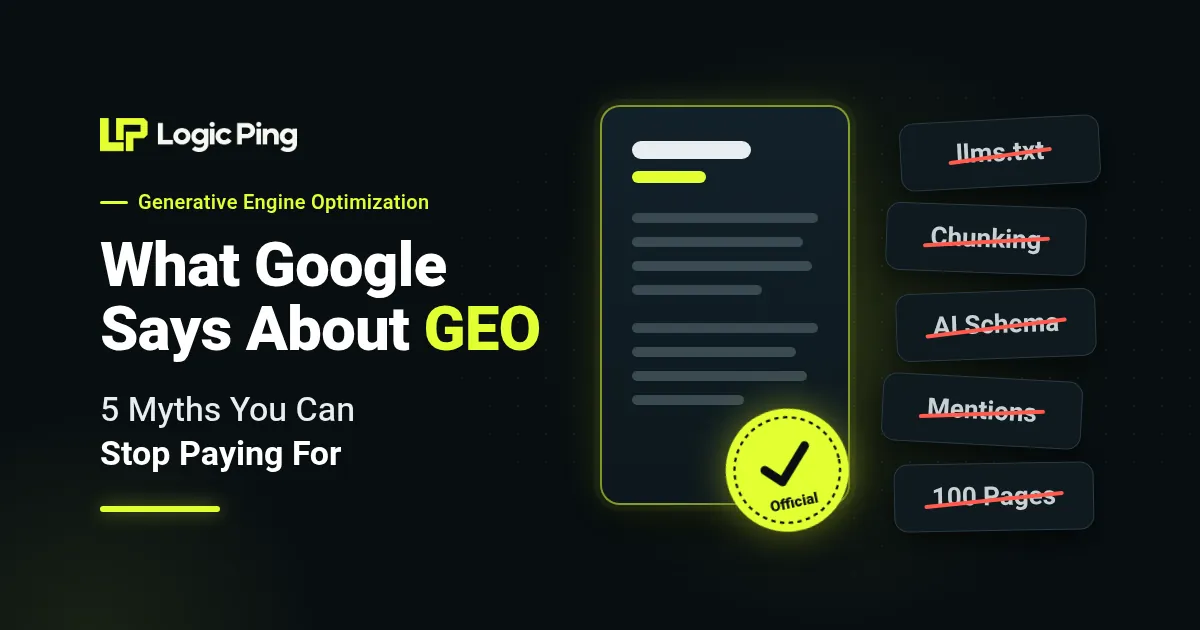
- Google says explicitly: optimizing for AI-powered search is still SEO.
- Google Search doesn’t use special AI files such as llms.txt.
- There’s no need to break content into tiny chunks or write in a special style for AI.
- There’s no special Schema markup for the AI features, and inauthentic mentions don’t help as much as people think.
- Pages for every variation of a query violate Google’s spam policies.
Google’s guide, in brief
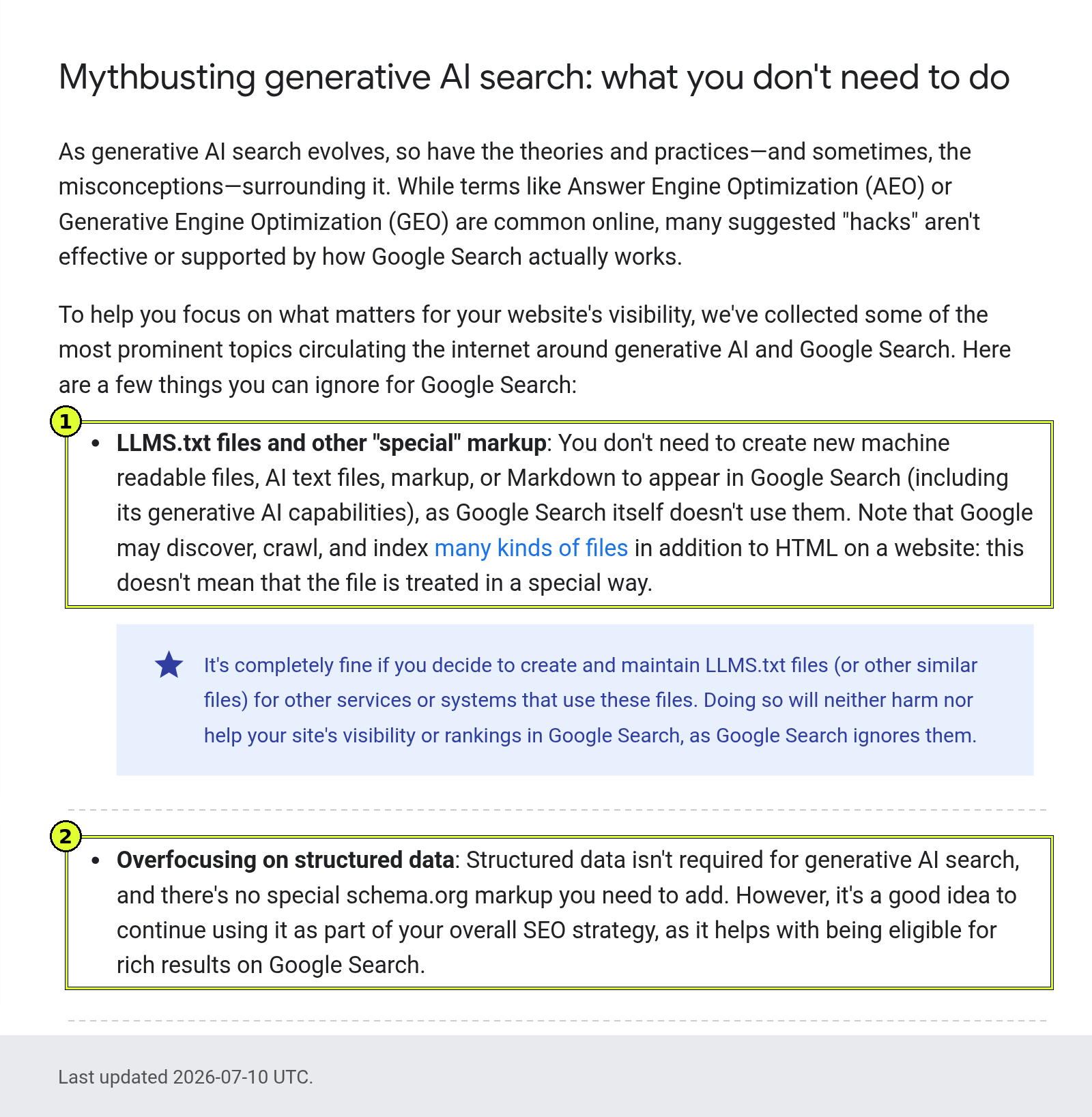
The guide is called “Optimizing your website for generative AI features on Google Search”, and it was last updated on July 10, 2026. It covers AI Overviews and AI Mode.
Its core message comes up several times: AI answers rely on the same index and the same ranking systems as regular search. So what helps you appear in search also helps you appear in answers. Google recommends checking any third-party GEO or AEO advice against its own guidance.
For the background, and how an AI engine builds an answer, see our guide What Is GEO?.
Myth 1: You need an llms.txt file to appear in answers
llms.txt is a proposed format that gathers a site’s content for language models. It’s sold today as part of GEO packages, sometimes as the main ingredient.
What Google says: there’s no need to create new machine-readable files to appear in Search, because Google Search doesn’t use them. Creating such a file won’t help or hurt your visibility in Search.
What actually works: a site that is crawled and indexed, with a valid sitemap and pages that answer real questions.
Myth 2: You need to break content into small chunks for AI
The idea: models “pull” individual paragraphs, so you should write short, self-contained chunks, each with a question and an answer.
What Google says: there’s no requirement to break content into tiny pieces for AI. Its systems understand a page that covers several topics. There’s also no need to write in a special way for AI-powered search. Write for your audience.
What actually works: a page that answers the question right at the start, with clear headings and a structure that’s easy to scan. It helps readers, and so it helps the engines too.
Myth 3: You need special Schema markup for AI
Some providers offer “GEO markup” or new Schema types that are supposed to get your site into answers.
What Google says: structured data isn’t required for AI-powered search, and there’s no special schema.org markup to add. Google also warns against over-focusing on structured data.
What actually works: regular structured data, such as Article, Organization and FAQPage when the questions actually appear on the page, still helps Google understand the page and show rich results.
Myth 4: Mentions across the web will get you into answers
The idea: AI engines cite what is written about you elsewhere, so you should generate mentions. In practice that looks like sponsored articles, forum comments or “top companies” lists written for the purpose.
What Google says: seeking inauthentic mentions across the web isn’t as useful as it seems. Its ranking systems focus on quality content, and other systems block spam.
What actually works: mentions that come naturally: customer reviews, listings in professional directories, interviews, and original data that others want to cite.
Myth 5: A page for every variation of a query
The idea: if people ask the same question in dozens of phrasings, you should have a page for each phrasing, or a page for each city.
What Google says: creating separate pages for every query variation to manipulate rankings or AI answers violates its spam policies (scaled content abuse). A high number of pages doesn’t make a site better.
What actually works: one strong page per topic that also answers the follow-up questions. The engine splits the question itself, and looks for a page that answers the parts.
So what does work?
| Instead of | Do this |
|---|---|
| An llms.txt file | Make sure the site is crawled and indexed, with no blocks on crawlers |
| Special writing for AI | Write for readers, with the answer up front and a clear structure |
| Special markup | Regular, correct structured data |
| Inauthentic mentions | Reviews, professional directories, interviews and original data |
| A page per phrasing | One strong page per topic that also answers the follow-up questions |
And above all: measure. The AI performance report in Search Console, chat traffic in GA4, and a monthly check of the same questions. That way you know what works, instead of guessing.
Frequently asked questions
If GEO is SEO, why talk about GEO at all?
Because something did change: questions are longer, engines split each question into sub-searches, and what others write about you matters more. The work is still SEO, but you need to cover full questions and also measure how you appear in answers.
Should I remove the llms.txt file from my site?
No need. Google says creating such a file won’t help or hurt in its Search. Just don’t pay for it as a service, or expect it to make a difference.
Does this guidance apply to ChatGPT too?
The guide covers Google Search only. ChatGPT and Perplexity search the web in their own ways, but they also cite pages found through search. A site that ranks well and answers the question is a good starting point in every engine.
Is structured data (Schema) unnecessary now?
No. Google says there’s no special markup for its AI features, but structured data still helps it understand the page and show rich results. It’s part of good SEO, not a shortcut to AI.
How can I tell whether a GEO provider is selling a myth?
Ask exactly what will be done on the site and why. If the answer is a file, special markup or “writing for AI”, without work on content, rankings and measurement, that’s the place to ask questions. The full list is in How to Choose a GEO Agency.
Sources: Optimizing your website for generative AI features, Google Search Central · Spam policies for Google web search, Google Search Central · AI features and your website, Google Search Central.
Got a GEO proposal and not sure what’s in it?
In a second opinion, we go through the proposal or the existing work and check what relies on Google’s guidance and what relies on myths. You leave knowing what to ask for, and what not to pay for.