Key takeaways:
- GEO is built on SEO. An agency that sells GEO without checking indexing, rankings and content skips the layer the answers are drawn from.
- A real service starts with an audit and a baseline: the questions customers ask, what the engines answer today, and who gets cited.
- No one can guarantee you’ll appear in a ChatGPT answer. No agency has special access to OpenAI or Google.
- “Top GEO agencies” lists are often paid placements. They don’t prove experience.
- Measure leads and change against the baseline, not a “ChatGPT ranking”, which doesn’t exist.
What a GEO agency should actually do
GEO is a new term, so proposals from different agencies look completely different. These are the five components a full service should include, and what you get from each:
| Component | What they do | What you get |
|---|---|---|
| Audit and baseline | Ask ChatGPT, Gemini, Perplexity and AI Mode the questions your customers ask, and review Search Console | A current-state sheet: who is mentioned, who is cited and which pages rank |
| Technical foundations | Check crawling, indexing, robots.txt, AI crawler blocks and structured data | A prioritized list of fixes |
| Content | Pages that answer the buyer’s full questions, with first-hand experience and data you can’t find elsewhere | A content plan and improved pages |
| Off-site presence | Business profiles, vendor directories, articles and real partnerships, with consistent business details everywhere | A list of sources worth being in |
| Measurement | The AI report in Search Console, chat traffic in GA4, and a monthly check of the same questions | A monthly report against the baseline |
A proposal that covers only the content row, or only an llms.txt file and Schema markup, covers a small part of the work. We covered the foundations in What Is GEO?.
Does a GEO agency need to understand SEO?
Yes. Google says in its official guide that optimizing for its AI features is still SEO, and that the answers are drawn from the same index and the same ranking systems. ChatGPT and Perplexity also search the web before answering a current question, and cite pages they found in search.
That gives you a simple test for the meeting: ask the agency what it will look at in your Search Console in the first week. An agency that doesn’t plan to open Google’s reports will struggle to explain why a page isn’t making it into the answers.
10 questions for the first meeting, and what to listen for
Ask every agency that sends a proposal these questions, in the same words. That way you can compare the answers afterwards.
| The question | A good answer | A warning sign |
|---|---|---|
| 1. What will you look at in the first month? | An audit: customer questions in the engines, Search Console, technical foundations and competitors | Jumping straight into writing content or placing articles |
| 2. What baseline will you set? | A fixed list of questions, checked in several engines, recording who is mentioned and what is cited | “We’ll check in our tool” without explaining what it measures |
| 3. What will you check in our SEO? | Indexing, how service pages rank, crawler blocks, speed | “GEO is a separate field, it has nothing to do with SEO” |
| 4. Which engines will you check, and why those? | Based on the audience: Google AI Overviews and AI Mode, ChatGPT, Gemini, Perplexity, Copilot | Only ChatGPT, no Google |
| 5. What will you do off-site? | Map the sources the engines cite in your space, with a plan to get into them | A package of articles or links at a fixed price |
| 6. How will you measure success? | Change against the baseline, leads from chats and search, impressions in the AI report | “The top spot in ChatGPT” |
| 7. What will you need from us? | Access to Search Console and GA4, time with someone who knows the customers, access to the site or a developer | “Nothing, we take care of everything” |
| 8. Who owns the content and accounts? | You own everything: content, profiles and access, even if the work stops | Profiles or content that stay in the agency’s name |
| 9. Can we see previous work? | Before-and-after data from a real client, even without the name | A single screenshot of an answer that mentions a client |
| 10. When will we see change, and what if we don’t? | Technical changes within weeks, content after a few months, a checkpoint agreed in advance | A promise to appear within two weeks |
Question 2 matters most. Without a baseline set before anything changes, there’s no way to tell whether the work made a difference. You can check the first baseline questions yourself, even before the meeting, using our ChatGPT visibility check.
Red flags: promises no one can keep
| What you hear | Why it’s a problem |
|---|---|
| “We’ll get you the top spot in ChatGPT” | AI answers vary from question to question and from user to user. There’s no fixed ranking anyone can guarantee. |
| “We have a partnership with OpenAI or Google” | No vendor can influence the answers. Google explicitly warns about tools that claim access to its internal systems. |
| “An llms.txt file and special markup will get you into the answers” | Google says it ignores special files for AI. They don’t hurt, but they aren’t a service. |
| “We’ll write 100 pages a month for you” | Pages produced at scale to capture queries violate Google’s spam policies (scaled content abuse). |
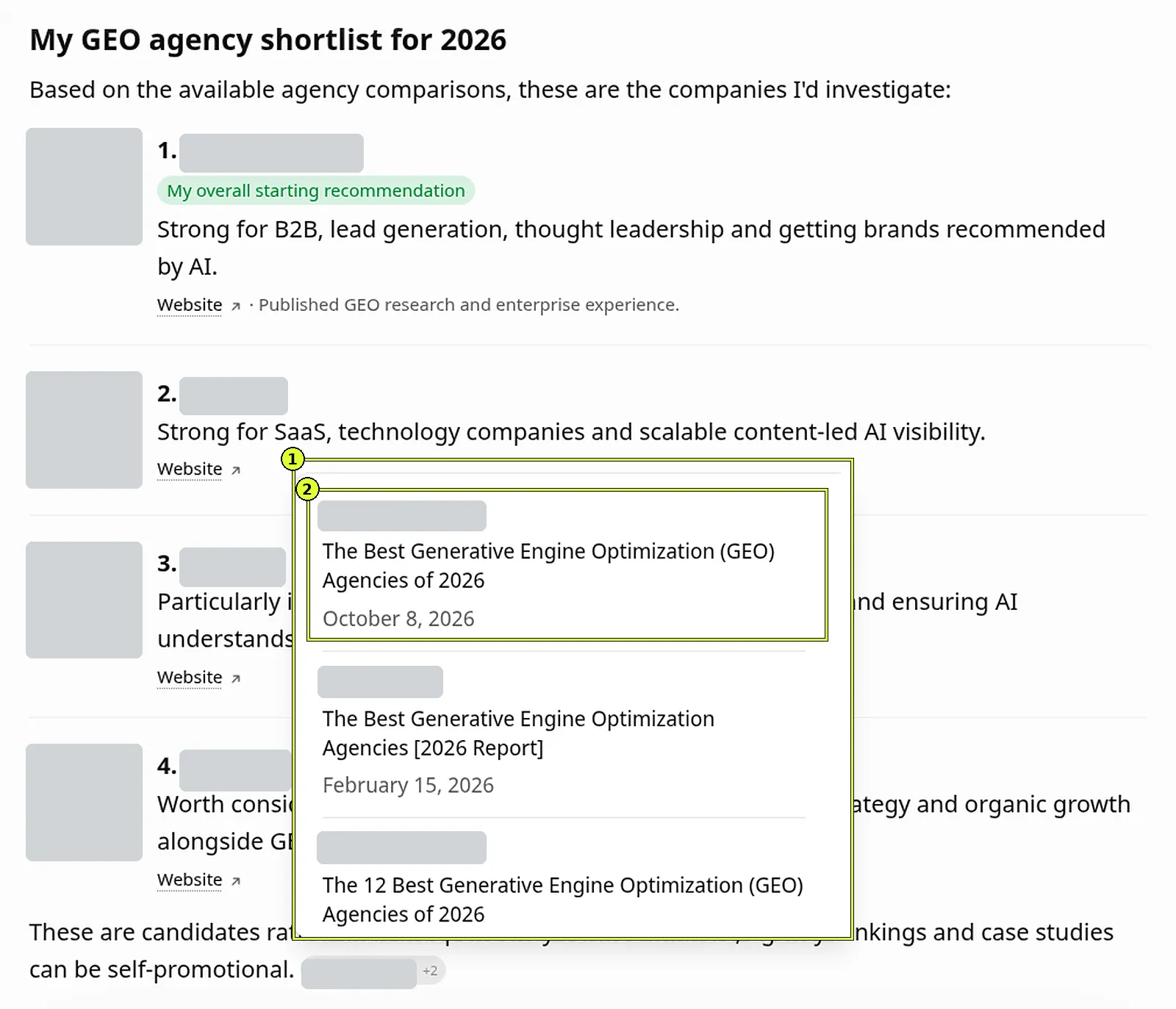
| “We’ll get you onto the top agencies list in a major publication” | That’s a sponsored article. It’s legitimate when it’s labeled as sponsored, but it’s a media buy, not GEO work. |
| “You’ll see results in two weeks” | New content first has to be indexed and ranked. What the models learned in training only changes with a new version. |
| “You can buy a spot in the answer” | In ChatGPT you can buy an ad, and it’s labeled as sponsored and kept separate from the answer. A mention inside the answer itself can’t be bought. |
How to measure whether the work is working
A GEO agency’s monthly report should show change against the baseline, across four measures:
- The same questions, in the same words. How many questions mention the business, in how many engines, and what changed in the sources cited.
- The generative AI performance report in Search Console. The site’s impressions in Google’s AI features.
- Chat traffic in GA4. Visits from ChatGPT, Perplexity, Gemini and Copilot, and how many became leads.
- Leads. How many new customers said they found you in a chat or in search. It’s worth adding the question to your contact form.
We covered the tools themselves in What Is GEO?, in the section on measurement.
How much does a GEO agency cost, and what drives the price
There’s no single price, because the work depends on the state of the site and the field. These are the factors that change the scope:
- The state of your SEO. A site that can’t be found on Google first needs technical and content work, and only then a GEO layer.
- How much content is missing. Pages that answer the buyer’s questions are usually the biggest component.
- Off-site work. PR, partnerships and listings in professional directories take time.
- Who does the work. When you have a writer and a developer in-house, consulting that directs the work is sometimes enough.
Look at how the proposal is structured: good work starts with a defined audit, and only then comes a proposal for ongoing work. A proposal that arrives before anyone has looked at your site is an estimate, not a plan.
GEO agency, consultant or in-house?
| Approach | When it fits | What you need on your side |
|---|---|---|
| An agency that does everything | No one in-house writes or updates the site | Someone who approves content and provides expertise |
| A consultant who directs the work | You have a writer, developer or marketer who can execute | Time to execute and someone who owns the priorities |
| In-house | You have a marketing team with SEO experience | A fixed monthly check and someone who follows changes in the engines |
What to do now
- Ask ChatGPT and Google AI Mode three questions your customers ask, and save the answers. That’s your baseline.
- Print the 10 questions from the table and ask every agency, in the same order.
- Ask for a sample of a real monthly report from a current client, even without the name.
- Make sure the proposal starts with an audit and sets an agreed checkpoint.
- Check that the contract keeps all accounts and content in your name.
Frequently asked questions
What’s the difference between a GEO agency and an SEO agency?
A GEO agency also measures the answers AI engines give and works on the sources they cite. The foundation is shared: indexing, rankings and good content. An agency that does only one of them misses part of the picture.
Does a sponsored article help you appear in ChatGPT?
It can get cited, because engines read articles. But it’s a media buy. It doesn’t replace good content on your site and mentions that are earned.
How long does it take to see results from a GEO agency?
Technical fixes, such as unblocking crawlers, can have an effect within days or weeks. New content usually shows a change after a few months.
Is a tool that shows an “AI visibility score” enough?
Tools like these help track a trend, but each one measures different questions in a different way. What matters is which questions were checked, and whether they are really the questions your customers ask.
What should we ask an agency we already work with?
What the baseline was, what has changed since, and which changes were made to the site last month. If there’s no clear answer, consider a second opinion.
Sources: Optimizing your website for generative AI features, Google Search Central · Spam policies for Google web search, Google Search Central · Ads in ChatGPT, OpenAI Help Center.
Want a GEO plan before you choose a vendor?
In a consulting session, we look with you at what the engines say about your business today, what’s missing on your site, and what the proposals you get should include. You leave with a work plan, whether you carry it out with us or with another vendor.