Key takeaways:
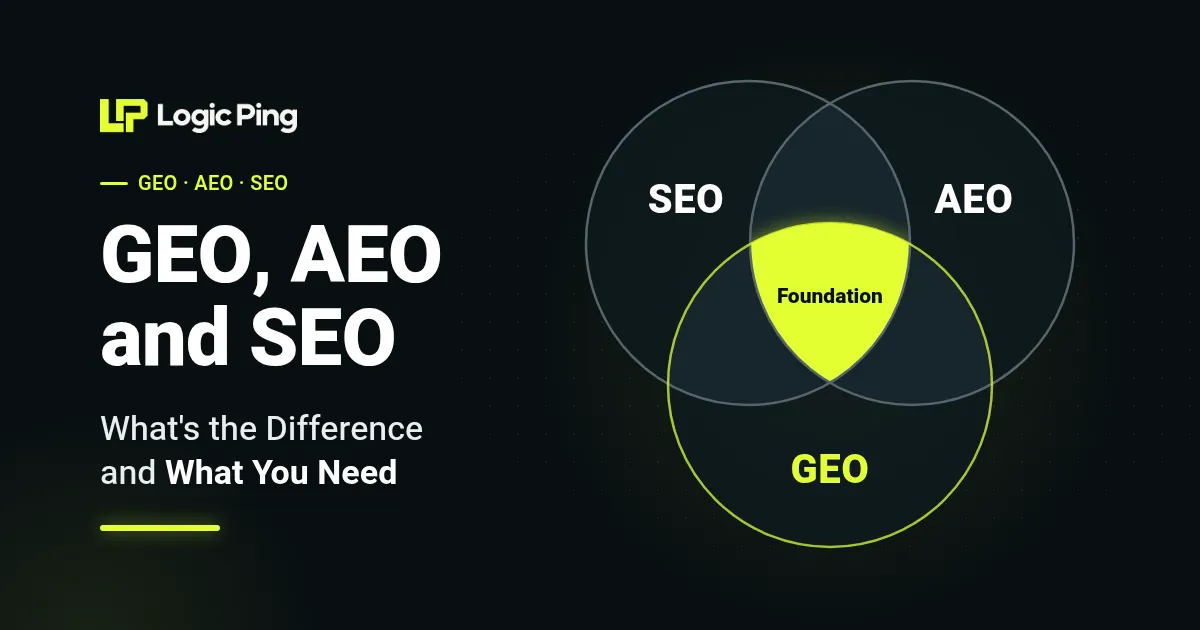
- SEO, AEO and GEO share one goal across three types of results: a list of links, a direct answer and an AI answer.
- The foundation is shared: a crawlable site, pages that answer real questions, and trust from outside the site.
- Google says explicitly that optimizing for AI-powered search is still SEO.
- What changes between businesses is the order of priorities: a local business, B2B and a store need to start in different places.
- Measure each layer separately, but invest in the shared foundation first.
Three names, one goal
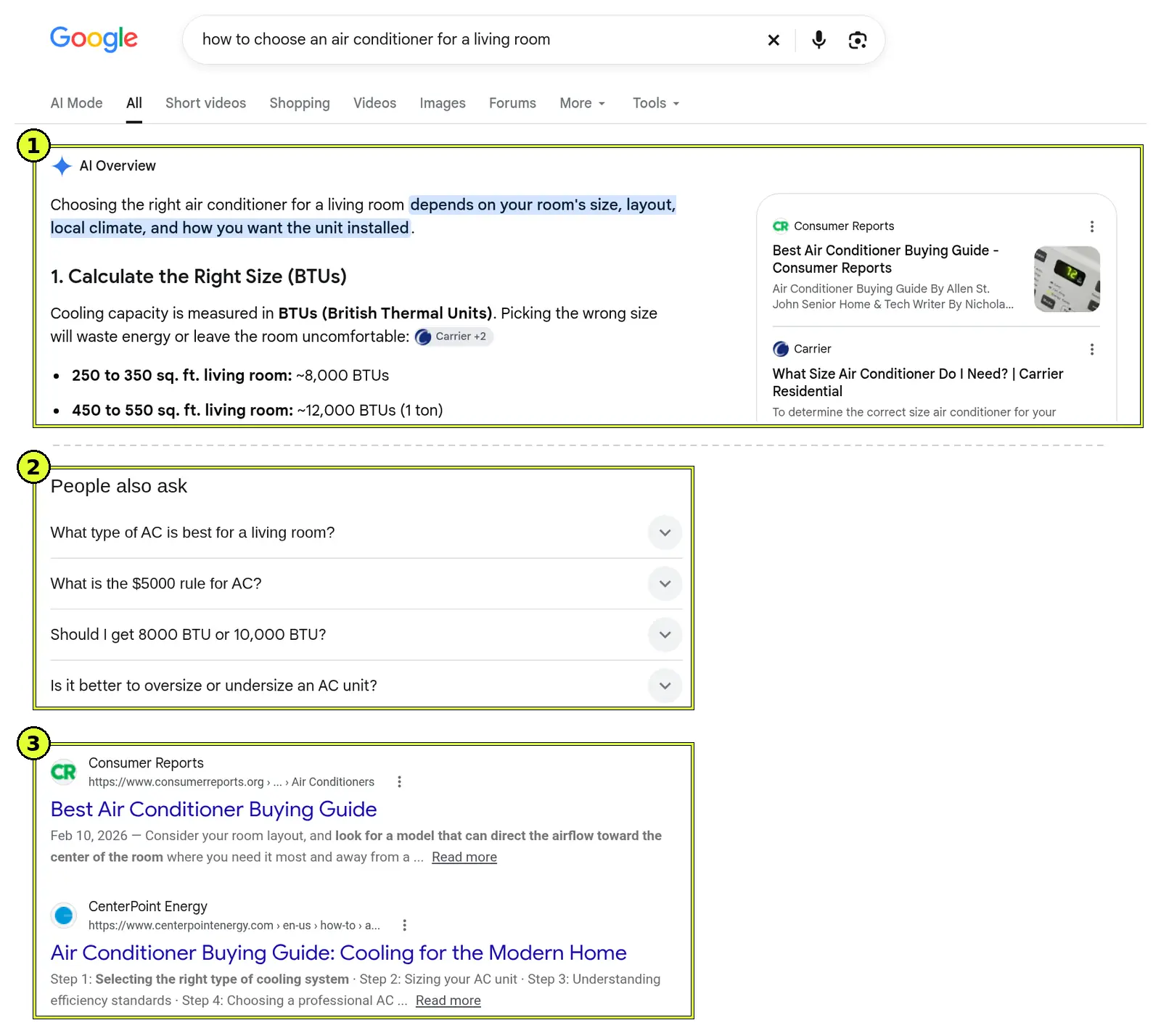
A customer looking for a provider can now see three things on the same page: an AI overview that summarizes an answer, a box of related questions with short answers, and a list of sites. Each is a chance to be the one the customer meets.
- SEO (Search Engine Optimization) is about your place in the list of results. Success is measured in clicks.
- AEO (Answer Engine Optimization) is about the direct answer: a featured snippet, People also ask, a voice assistant. Success is your site being the source of the answer.
- GEO (Generative Engine Optimization) is about the answers a language model writes, in Google, ChatGPT, Gemini and Perplexity. Success is a mention, a citation and a link.
For how an AI engine builds an answer and chooses sources, see our guide What Is GEO?.
What the three share
Google says in its official guide that AI answers rely on the same index and the same ranking systems as regular search. In other words, the foundation is the same:
- Infrastructure. A site that is crawled, indexed and doesn’t block crawlers.
- Content. A page for each service that answers the question right at the start, and also covers the follow-up questions.
- Trust. Reviews, mentions and outside sources that confirm what you say about yourself.
So a business investing in good SEO is already doing most of the work of AEO and GEO. A service that offers GEO without touching the foundation, such as just an llms.txt file or “writing for AI”, skips the stage that answers are drawn from. We cover the common myths in What Google Says About GEO.
What’s different between the three
| SEO | AEO | GEO | |
|---|---|---|---|
| Type of query | Short: “SEO agency Chicago” | A direct question: “how long does SEO take” | A full question with context: “which agency fits a B2B company selling abroad” |
| What wins | A page that ranks high | A short, clear answer on the page | A page that covers the question and the follow-ups, and outside sources that mention you |
| What you measure | Clicks, impressions, position | Appearing in featured snippets and People also ask | Appearing in the AI report, chat traffic, a monthly manual check |
| What happens next | The user visits sites and compares | The user gets an answer, sometimes without a click | The user sees a recommendation, and sometimes visits only one site |
The biggest practical difference is in the last row. In an AI answer, the comparison has already been made for the user. If you’re not mentioned there, you’re not part of the conversation.
What your business needs: a decision table
The foundation is shared by everyone, but the order of priorities differs by business type:
| Business type | Where to start | What to add next |
|---|---|---|
| Local business (contractor, clinic, law firm) | Google Business Profile, a page for each service with service area and prices, reviews | Local guides and provider directories that AI engines cite |
| B2B and professional services | Pages that answer buyer questions at each stage, case studies, first-hand content | Mentions in provider guides, articles and original data, and a monthly check in ChatGPT |
| Online store | Crawlable categories and products, original descriptions, product structured data | Buying guides and comparisons that answer pre-purchase questions |
| New business | Sound infrastructure, a page for each service, a clear sentence defining who you are | Building trust: reviews, profiles and directory listings |
For every type, the first step is the same: check what exists today. What ranks, which pages are missing, and what the engines answer to your customers’ questions.
What to do now
- Check in Search Console which queries already bring impressions, and at what position.
- Ask ChatGPT and Google three questions your customer asks, and save the answers.
- List your main services, and check that each one has its own page answering the questions about it.
- Add measurement: the AI report in Search Console and chat traffic in GA4.
We cover the stages of SEO, the foundation for all three, in our Organic SEO guide.
Frequently asked questions
If my SEO is good, do I need GEO?
In most cases, good SEO is most of the work. What GEO adds: covering full questions and follow-up questions, working on the sources AI engines cite in your field, and measuring how you appear in answers.
What is AEO, and how is it different from GEO?
AEO (Answer Engine Optimization) is about a direct answer from a single source: a featured snippet, People also ask or a voice assistant. GEO is about an answer a language model writes from several sources. In practice the work overlaps almost completely.
Does GEO replace SEO?
No. Google says optimizing for AI-powered search is still SEO, and answers are drawn from the same index. A site that doesn’t rank will rarely appear in answers.
How do you measure each one?
SEO: clicks, impressions and position in Search Console. AEO: appearing in featured snippets and People also ask. GEO: the AI performance report in Search Console, chat traffic in GA4, and a monthly check of fixed questions.
Where do we start?
With a check of what exists: what ranks today, which pages are missing, and what the engines answer to your customers’ questions. Most businesses find the biggest gap is in the foundation, not in the AI layer.
Sources: Optimizing your website for generative AI features, Google Search Central · AI features and your website, Google Search Central · Featured snippets and your website, Google Search Central.
Not sure where to start?
In a site audit, we check all three layers: what ranks, what appears in direct answers, and what AI engines say about your business. You leave knowing where the biggest gap is, and what to do first.